
'Every period of excessive optimism eventually gives way to a correction, while periods of extreme pessimism often create the best investment opportunities.'

The IRGC is the most powerful branch of Iran's armed forces and operates independently of the country's regular military, answering directly to Supreme Leader Ali Khamenei.

History may remember Takaichi Sanae not as the leader who simply accelerated Japanese rearmament, but as one who governed during Japan's transition from an industrial-age security model to a post-industrial strategic member of the global order, points out Varun Arya.

'Markets never fully lose hope. But an important shift could come if the Strait remains closed -- moving from high prices to no prices.'

Indian stock market benchmark indices Sensex and Nifty closed nearly one per cent higher, extending their winning streak for a second day. This rally was driven by softening crude oil prices, positive geopolitical developments, and significant buying in blue-chip IT stocks, despite a broader global tech sell-off.

Beijing clearly intends to extend the China-Myanmar Economic Corridor to Bangladesh as part of its larger Maritime Belt and Road Initiative to boost its Indian Ocean presence.

For the foreseeable future, the most likely outcome remains continuation of the status quo. Taiwan will remain self-governing without formally declaring independence, while China continues to apply sustained pressure short of war, predict Krishnan Srinivasan and Manoj Mohanka.

The judgment is India's first to examine AI companies' use of copyrighted works for foundation models, setting an analytical framework for Section 52 of the Copyright Act.

Dinesh Trivedi's success or failure in this fragile diplomatic equilibrium will have consequences extending well beyond the Indian high commission in Dhaka. It will shape India's eastern strategic environment for years to come.

A NITI Aayog report outlines India's potential to scale its bioeconomy to USD 691 billion by 2035 and USD 2.6 trillion by 2047, creating over 30 million high-value jobs. The report stresses the need for coordinated national execution, regulatory reforms, a strengthened talent pipeline, and a significant BioEconomy Growth Fund to achieve this vision, positioning India among the top biotechnology powers globally.
The US and India are collaborating to de-risk global supply chains for artificial intelligence technologies, particularly in semiconductor manufacturing and critical minerals processing. This partnership is facilitated through the US-led Pax Silica initiative, which aims to address over-concentration issues and single points of failure in supply chains, fostering a resilient global economy.

Bajaj Finserv announced a strategic initiative to invest up to Rs 2,000 crore in artificial intelligence and technology-led startups over the next five years, along with a collaboration with IIT-Bombay for joint research.

The Directorate of Revenue Intelligence (DRI) has dismantled a major gold-smuggling syndicate at Chhatrapati Shivaji Maharaj International Airport, seizing 3.2 kg of gold worth Rs 5 crore. Seven individuals, including Bangladeshi and Sri Lankan nationals and three airport staff, have been arrested in connection with "Operation Golden Nexus."

The aim is to win over the country's enterprises, developers and startups as AI systems shift from answering questions to autonomously executing tasks.

Punjab Police has dismantled the financial infrastructure of drug-trafficking networks, freezing assets worth Rs 300 crore linked to alleged drug smugglers.

The H-1B visa once symbolised the American Dream for Indians, but today's students are increasingly asking whether they need America at all. In 1995, the question was: How do I get to America? In 2026, it may be: Do I need to?

India significantly increased its crude oil imports from Russia and the United Arab Emirates in June, securing supplies as the Strait of Hormuz began to reopen, with Russian barrels remaining attractive due to discounts and UAE supplies offsetting earlier uncertainties.

The Beijing summit may have reduced immediate diplomatic uncertainty, but it did not resolve the deeper structural contest between the United States and China. That contest appears likely to define the coming decade, notes Varun Arya.

Streaming has globalised the entertainment industry, enabling artists like Diljit Dosanjh and Arijit Singh to reach diverse international audiences.

'The flip side of this is that he won't hesitate to call out India if he thinks its policies are hurting US economic interests or border US foreign policy goals.'
Financial Intelligence Unit detects over Rs 7,800 cr blackmoney.

'Today, we see people go on ChatGPT to ask 'can you plan my holiday' and then they have to go outside of the ChatGPT window to make all the bookings and so how can we complete that really high-intent use case that a user has come to ChatGPT with and help them complete that all the way within the chat GPT window.'
Telangana's EAGLE Force, in coordination with Customs and NCB, has dismantled an international 'OG Ganja' smuggling ring operating between Bangkok and India. The operation led to the arrest of a woman junior artist and the seizure of 2.15 kg of cannabis, exposing a larger syndicate that exploits vulnerable women as drug carriers.

Sterlite Technologies plans to invest up to USD 100 million in the US to strengthen its manufacturing capacity for AI data centres and telecom customers.
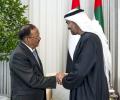
India is the only significant power that all parties trust, or at least do not distrust, notes former defence secretary Ajay Kumar.

Prime Minister Narendra Modi inaugurated the 594-km-long Ganga Expressway, connecting Meerut to Prayagraj, aiming to boost connectivity, industrial investment, and economic growth in Uttar Pradesh.

The Directorate of Revenue Intelligence (DRI) has dismantled a major international gold smuggling syndicate operating through Kempegowda International Airport in Bengaluru, arresting five individuals and seizing a significant quantity of gold.

The US has seized an oil tanker, 'Skywave', linked to Iran in the Indian Ocean, as part of efforts to disrupt Iran's oil shipments and enforce sanctions. The vessel was part of a network transporting sanctioned Iranian crude oil, with the seizure occurring amid heightened tensions between Washington and Tehran.

A readout by the US said the agreement marked a milestone in the strategic partnership between the two nations to ensure that the foundational elements required for advanced technology and energy are available within trusted networks.
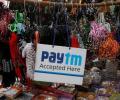
Fintech giant Paytm reports a consolidated profit of Rs 183 crore in Q4 FY26, marking a significant turnaround driven by its core payments business, growth in loans, and consumer-side profitability. The company is also prioritising investments in AI and has ruled out applying for an NBFC licence.

India emerged reasonably well from 2025. But now, the oil shock and war-related supply disruptions have again driven funds out of India and significantly weakened the rupee, points out Ajay Chhibber.

Brokerage Bernstein has warned Prime Minister Narendra Modi that India risks squandering recent economic gains unless it accelerates structural reforms, particularly in jobs, manufacturing and innovation.

'Historically, India has depended on the Middle Eastern Gulf for nearly 90 per cent of its LPG imports. Shifting to alternative suppliers is not something that can happen quickly.'
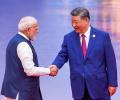
For India, China's Indian Ocean power projection, maritime domain awareness, dual-use ports, underwater surveillance, antisubmarinewarfare, naval exercises with Pakistan, pose considerable pressure, depleted India's strategic depth and marginalises Indian role, points out Srikanth Kondapalli.
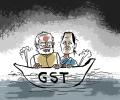
Kapil Chugh, accused of masterminding a Rs 1,825 crore GST refund fraud, has been arrested by DGGI officers upon his return from Dubai. He is alleged to have evaded investigation and is wanted in other economic criminal cases.
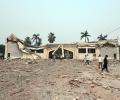
'We won not (only) because we were able to carry out long-range precision strikes.' 'That is, of course, one of the reasons but we had better situational awareness about what's happening than Pakistan.'

Indian IT services companies are set to significantly increase their acquisition spending to $6.5-7 billion this year, up from $5 billion last year, as they seek to boost revenue and capabilities in areas like Cloud, data, enterprise platforms, and AI amidst a challenging economic environment.

India has joined the US-led 'Pax Silica' alliance, aimed at building a resilient supply chain for critical minerals and artificial intelligence, marking a significant step in strengthening bilateral ties and fostering economic security.

Prime Minister Narendra Modi has begun a six-day tour of the UAE, the Netherlands, Sweden, Norway and Italy to strengthen bilateral relations amid geopolitical challenges. The trip will focus on energy security, trade, and technological cooperation.

Iran has placed anti-personnel and anti-armour mines around the island, where US troops could potentially stage an amphibious landing.
